
O granito é um tipo de rocha ígnea extraída por sua extrema resistência, densidade, durabilidade e resistência à corrosão. Mas o granito também é muito versátil – não serve apenas para formatos quadrados e retangulares! Na verdade, trabalhamos com confiança com componentes de granito projetados em formatos, ângulos e curvas de todas as variações regularmente – com excelentes resultados.
Graças ao nosso processamento de última geração, as superfícies de corte podem ser excepcionalmente planas. Essas qualidades fazem do granito o material ideal para criar bases de máquinas e componentes de metrologia com dimensões e designs personalizados. O granito é:
■ usinável
■ Precisão total após o corte e acabamento
■ resistente à ferrugem
■ durável
■ longa duração
Os componentes de granito também são fáceis de limpar. Ao criar projetos personalizados, certifique-se de escolher o granito por seus benefícios superiores.
NORMAS / APLICAÇÕES DE ALTO DESGASTE
O granito utilizado pela ZHHIMG para os nossos produtos de placas de superfície padrão possui alto teor de quartzo, o que proporciona maior resistência ao desgaste e a danos. Nossas cores Preto Superior têm baixa taxa de absorção de água, minimizando a possibilidade de ferrugem dos seus instrumentos de medição de precisão enquanto estiverem sobre as placas. As cores de granito oferecidas pela ZHHIMG resultam em menor brilho, o que significa menos cansaço visual para quem utiliza as placas. Selecionamos nossos tipos de granito considerando a expansão térmica, buscando minimizar esse aspecto.
APLICAÇÕES PERSONALIZADAS
Quando sua aplicação exigir uma placa com formatos personalizados, insertos roscados, ranhuras ou outros acabamentos usinados, você vai querer selecionar um material como o Black Jinan Black. Este material natural oferece rigidez superior, excelente amortecimento de vibrações e usinabilidade aprimorada.
É importante observar que a cor, por si só, não indica as qualidades físicas da pedra. Em geral, a cor do granito está diretamente relacionada à presença ou ausência de minerais, o que pode não ter influência nas qualidades que tornam o granito um bom material para placas de superfície. Existem granitos rosa, cinza e preto que são excelentes para placas de superfície, assim como granitos pretos, cinza e rosa que são totalmente inadequados para aplicações de precisão. As características críticas do granito, no que diz respeito ao seu uso como material para placas de superfície, não têm relação com a cor e são as seguintes:
■ Rigidez (deflexão sob carga - indicada pelo Módulo de Elasticidade)
■ Dureza
■ Densidade
■ Resistência ao desgaste
■ Estabilidade
■ Porosidade
Testamos e comparamos diversos materiais de granito. Finalmente, chegamos à conclusão de que o granito preto de Jinan é o melhor material que já conhecemos. O granito preto indiano e o granito sul-africano são semelhantes ao granito preto de Jinan, mas suas propriedades físicas são inferiores. A ZHHIMG continuará buscando outros materiais de granito ao redor do mundo e comparando suas propriedades físicas.
Para conversarmos mais sobre o granito ideal para o seu projeto, entre em contato conosco.info@zhhimg.com.
Diferentes fabricantes utilizam padrões diferentes. Existem muitos padrões no mundo.
As especificações são baseadas em normas como a DIN Standard, ASME B89.3.7-2013 ou a especificação federal GGG-P-463c (placas de superfície de granito), entre outras.
E podemos fabricar placas de inspeção de precisão em granito de acordo com suas necessidades. Entre em contato conosco se desejar obter mais informações sobre outras normas.
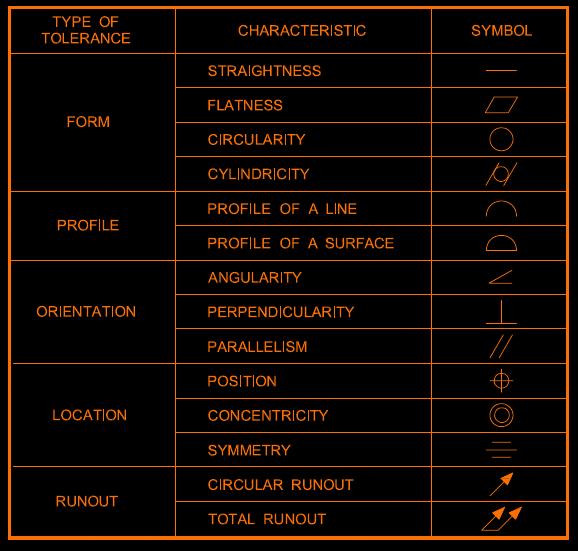
A planicidade pode ser considerada como a condição em que todos os pontos da superfície estão contidos em dois planos paralelos: o plano da base e o plano do teto. A medida da distância entre esses planos representa a planicidade geral da superfície. Essa medida de planicidade geralmente inclui uma tolerância e pode ser classificada por grau.
Por exemplo, as tolerâncias de planicidade para três classes padrão são definidas na especificação federal conforme determinado pela seguinte fórmula:
■ Grau de laboratório AA = (40 + diagonal ao quadrado/25) x 0,000001" (unilateral)
■ Grau de Inspeção A = Grau de Laboratório AA x 2
■ Ferramentaria Grau B = Laboratório Grau AA x 4.
Para placas de superfície de tamanho padrão, garantimos tolerâncias de planicidade que excedem os requisitos desta especificação. Além da planicidade, as normas ASME B89.3.7-2013 e a Especificação Federal GGG-P-463c abordam tópicos como: precisão de medição repetida, propriedades do material de granitos para placas de superfície, acabamento superficial, localização do ponto de apoio, rigidez, métodos aceitáveis de inspeção, instalação de insertos roscados, etc.
As placas de superfície e de inspeção de granito ZHHIMG atendem ou superam todos os requisitos estabelecidos nesta especificação. Atualmente, não existe uma especificação definida para placas angulares, paralelas ou esquadros mestres de granito.
E você pode encontrar as fórmulas para outros padrões emDOWNLOAD.
Primeiramente, é importante manter a placa limpa. A poeira abrasiva em suspensão no ar geralmente é a maior causa de desgaste em uma placa, pois tende a se incrustar nas peças de trabalho e nas superfícies de contato dos instrumentos de medição. Em segundo lugar, cubra a placa para protegê-la contra poeira e danos. A vida útil pode ser prolongada cobrindo a placa quando não estiver em uso, girando-a periodicamente para que uma única área não sofra desgaste excessivo e substituindo as almofadas de contato de aço dos instrumentos de medição por almofadas de carboneto. Além disso, evite colocar alimentos ou refrigerantes sobre a placa. Observe que muitos refrigerantes contêm ácido carbônico ou fosfórico, que podem dissolver os minerais mais macios e deixar pequenas cavidades na superfície.
Isso depende de como o prato está sendo usado. Se possível, recomendamos limpar o prato no início do dia (ou turno de trabalho) e novamente no final. Se o prato ficar sujo, principalmente com líquidos oleosos ou pegajosos, provavelmente deverá ser limpo imediatamente.
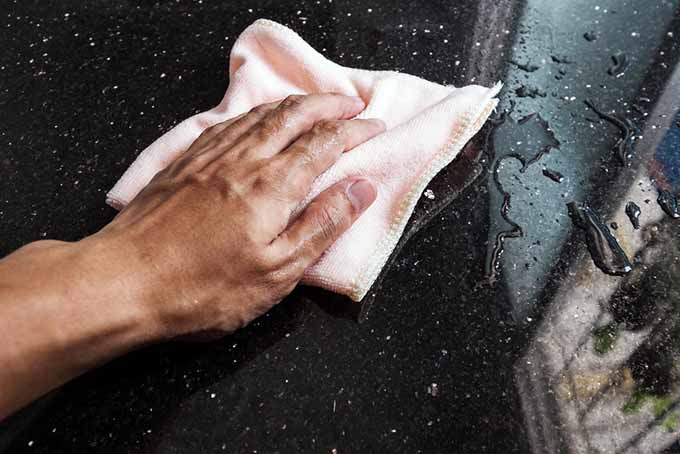
Limpe a placa regularmente com limpador de superfície líquido ou com o limpador de placas sem água ZHHIMG. A escolha da solução de limpeza é importante. Se for utilizado um solvente volátil (acetona, diluente de laca, álcool, etc.), a evaporação resfriará a superfície e a distorcerá. Nesse caso, é necessário permitir que a placa normalize antes de usá-la, caso contrário, ocorrerão erros de medição.
O tempo necessário para a normalização da placa varia de acordo com o tamanho da placa e o grau de resfriamento. Uma hora deve ser suficiente para placas menores. Duas horas podem ser necessárias para placas maiores. Se for utilizado um limpador à base de água, haverá também algum resfriamento por evaporação.
A placa também reterá água, o que pode causar ferrugem nas peças metálicas em contato com a superfície. Alguns produtos de limpeza também deixam um resíduo pegajoso após secarem, o qual atrairá poeira suspensa no ar e, na verdade, aumentará o desgaste em vez de reduzi-lo.
Isso depende do uso da placa e do ambiente. Recomendamos que uma nova placa ou acessório de granito de precisão seja totalmente recalibrado dentro de um ano após a compra. Se a placa de granito for submetida a uso intenso, pode ser aconselhável reduzir esse intervalo para seis meses. A inspeção mensal para erros de medição repetidos, utilizando um nível eletrônico ou dispositivo similar, mostrará quaisquer pontos de desgaste em desenvolvimento e leva apenas alguns minutos para ser realizada. Após a determinação dos resultados da primeira recalibração, o intervalo de calibração pode ser estendido ou reduzido conforme permitido ou exigido pelo seu sistema interno de qualidade.
Podemos oferecer um serviço para ajudá-lo a inspecionar e calibrar sua placa de superfície de granito.

Existem diversas causas possíveis para variações entre as calibrações:
- A superfície foi lavada com uma solução quente ou fria antes da calibração e não teve tempo suficiente para normalizar.
- A placa está mal apoiada.
- Mudança de temperatura
- Rascunhos
- A luz solar direta ou outras fontes de calor radiante não devem incidir sobre a superfície do prato. Certifique-se de que a iluminação superior não esteja aquecendo a superfície.
- Variações no gradiente vertical de temperatura entre o inverno e o verão (Se possível, conheça o gradiente vertical de temperatura no momento em que a calibração for realizada).
- A placa não teve tempo suficiente para normalizar após o envio.
- Uso inadequado de equipamentos de inspeção ou uso de equipamentos não calibrados.
- Alteração superficial resultante do desgaste
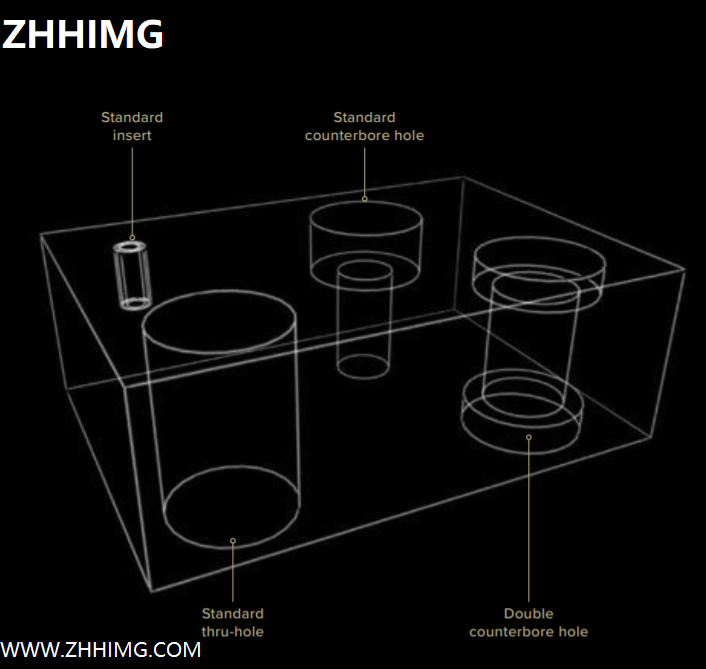
Quantos tipos de furos existem no granito de precisão?
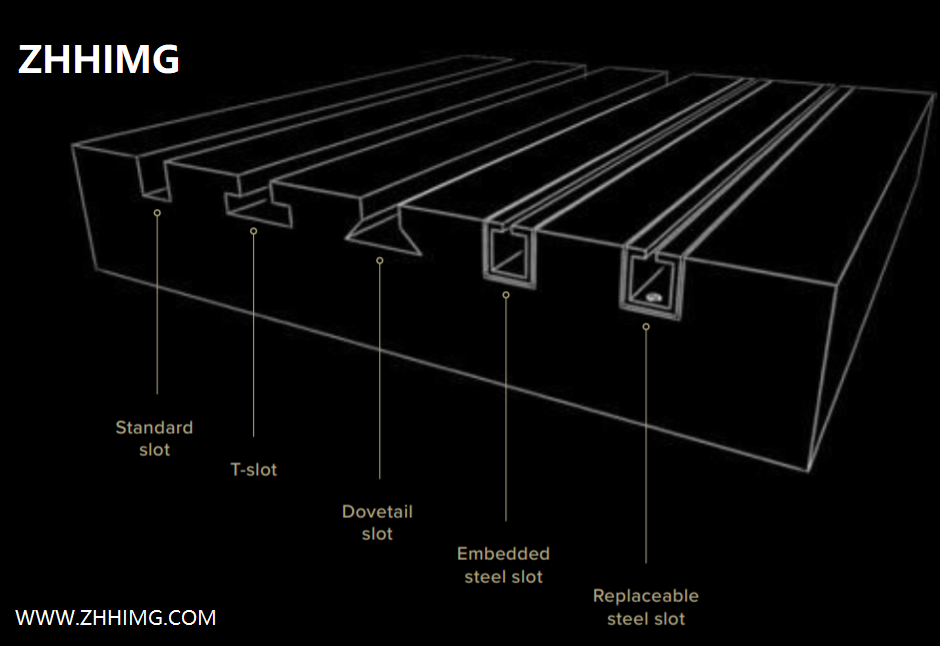
Ranhuras em componentes de granito de precisão
Para muitas fábricas, salas de inspeção e laboratórios, as placas de granito de precisão são essenciais como base para medições exatas. Como toda medição linear depende de uma superfície de referência precisa a partir da qual as dimensões finais são obtidas, as placas de granito oferecem o melhor plano de referência para inspeção e planejamento da peça antes da usinagem. Elas também são bases ideais para medições de altura e superfícies de referência. Além disso, o alto grau de planicidade, estabilidade, qualidade geral e acabamento fazem delas uma excelente opção para a montagem de sistemas sofisticados de medição mecânica, eletrônica e óptica. Para qualquer um desses processos de medição, é imprescindível manter as placas de granito calibradas.
Repita as medições e verifique a planicidade.
Tanto a planicidade quanto as medições repetidas são cruciais para garantir uma superfície de precisão. A planicidade pode ser considerada como a condição em que todos os pontos da superfície estão contidos em dois planos paralelos: o plano da base e o plano do topo. A medição da distância entre esses planos representa a planicidade geral da superfície. Essa medição de planicidade geralmente inclui uma tolerância e pode ser classificada por grau.
As tolerâncias de planicidade para três classes padrão são definidas na especificação federal, conforme determinado pela seguinte fórmula:
Norma DIN, norma GB, norma ASME, norma JJS... cada país tem sua própria norma...
Além da planicidade, a repetibilidade deve ser garantida. Uma medição repetida é uma medição de áreas de planicidade localizadas. Trata-se de uma medição realizada em qualquer ponto da superfície de uma placa, que se repetirá dentro da tolerância especificada. Controlar a planicidade de áreas localizadas com uma tolerância mais rigorosa do que a planicidade geral garante uma mudança gradual no perfil de planicidade da superfície, minimizando, assim, erros locais.
Para garantir que uma placa de superfície atenda às especificações de planicidade e repetibilidade de medições, os fabricantes de placas de granito devem usar a Especificação Federal GGG-P-463c como base para suas especificações. Esta norma aborda a precisão da repetibilidade das medições, as propriedades do granito da placa de superfície, o acabamento superficial, a localização dos pontos de apoio, a rigidez, os métodos aceitáveis de inspeção e a instalação de insertos roscados.
Verificação da precisão da placa
Seguindo algumas diretrizes simples, o investimento em uma placa de superfície de granito deve durar muitos anos. Dependendo do uso da placa, do ambiente da oficina e da precisão necessária, a frequência de verificação da precisão da placa de superfície varia. Uma regra geral é que uma placa nova seja totalmente recalibrada dentro de um ano após a compra. Se a placa for usada com frequência, é aconselhável reduzir esse intervalo para seis meses.
Antes que uma placa de superfície se desgaste além do especificado para planicidade geral, ela apresentará postes desgastados ou ondulados. A inspeção mensal para erros de medição repetida, utilizando um medidor de leitura repetida, identificará os pontos de desgaste. Um medidor de leitura repetida é um instrumento de alta precisão que detecta erros locais e pode exibir as informações em um amplificador eletrônico de alta ampliação.
Um programa de inspeção eficaz deve incluir verificações regulares com um autocolimador, fornecendo uma calibração precisa da planicidade geral, rastreável ao Instituto Nacional de Padrões e Tecnologia (NIST). Periodicamente, é necessária uma calibração completa realizada pelo fabricante ou por uma empresa independente.
Variações entre calibrações
Em alguns casos, existem variações entre as calibrações das placas de inspeção de superfície. Às vezes, fatores como alterações na superfície resultantes do desgaste, uso incorreto do equipamento de inspeção ou uso de equipamento não calibrado podem explicar essas variações. Os dois fatores mais comuns, no entanto, são a temperatura e o suporte.
Uma das variáveis mais importantes é a temperatura. Por exemplo, a superfície pode ter sido lavada com uma solução quente ou fria antes da calibração e não ter tido tempo suficiente para normalizar. Outras causas de variação de temperatura incluem correntes de ar frio ou quente, luz solar direta, iluminação direta ou outras fontes de calor radiante na superfície da placa.
Também podem ocorrer variações no gradiente vertical de temperatura entre o inverno e o verão. Em alguns casos, a placa não tem tempo suficiente para normalizar após o envio. É recomendável registrar o gradiente vertical de temperatura no momento da calibração.
Outra causa comum de variação na calibração é uma placa mal apoiada. Uma placa de superfície deve ser apoiada em três pontos, idealmente localizados a 20% do comprimento a partir das extremidades da placa. Dois apoios devem estar localizados a 20% da largura a partir dos lados maiores, e o apoio restante deve estar centralizado.
Apenas três pontos podem se apoiar firmemente em qualquer superfície que não seja de precisão. Tentar apoiar a chapa em mais de três pontos fará com que ela receba suporte de várias combinações de três pontos, que não serão os mesmos três pontos em que foi apoiada durante a produção. Isso introduzirá erros, pois a chapa se deformará para se adequar à nova configuração de suporte. Considere o uso de suportes de aço com vigas de apoio projetadas para se alinharem com os pontos de apoio corretos. Suportes para essa finalidade geralmente estão disponíveis junto ao fabricante da chapa.
Se a placa estiver devidamente apoiada, o nivelamento preciso só é necessário se a aplicação o especificar. O nivelamento não é necessário para manter a precisão de uma placa devidamente apoiada.
Prolongue a vida útil do prato
Seguir algumas orientações simples reduzirá o desgaste da superfície da placa de granito e, consequentemente, prolongará sua vida útil.
Primeiramente, é importante manter a placa limpa. A poeira abrasiva em suspensão no ar geralmente é a maior causa de desgaste em uma placa, pois tende a se incrustar nas peças e nas superfícies de contato dos medidores.
Também é importante cobrir as placas para protegê-las contra poeira e danos. A vida útil pode ser prolongada cobrindo as placas quando não estiverem em uso.
Gire a placa periodicamente para que uma única área não sofra desgaste excessivo. Além disso, recomenda-se substituir as almofadas de contato de aço dos medidores por almofadas de carboneto.
Evite colocar alimentos ou refrigerantes no prato. Muitos refrigerantes contêm ácido carbônico ou fosfórico, que podem dissolver os minerais mais macios e deixar pequenas cavidades na superfície.
Onde recair
Quando uma placa de granito precisa ser retificada, considere se o serviço deve ser realizado no local ou na empresa de calibração. É sempre preferível retificar a placa na fábrica ou em uma instalação especializada. No entanto, se a placa não estiver muito desgastada, geralmente dentro de 0,001 polegada da tolerância exigida, ela pode ser retificada no local. Se uma placa estiver desgastada a ponto de estar mais de 0,001 polegada fora da tolerância, ou se estiver muito corroída ou com marcas, ela deve ser enviada à fábrica para retificação antes da retificação.
Um laboratório de calibração possui os equipamentos e a configuração de fábrica que proporcionam as condições ideais para a calibração adequada das placas e, se necessário, para retrabalho.
É preciso ter muito cuidado ao selecionar um técnico para calibração e restauração de granito no local. Solicite credenciamento e verifique se o equipamento que o técnico utilizará possui calibração rastreável. A experiência também é um fator importante, pois leva muitos anos para aprender a lapidar granito de precisão corretamente.
Medições críticas começam com uma placa de granito de precisão como referência. Ao garantir uma referência confiável por meio de uma placa calibrada adequadamente, os fabricantes dispõem de uma das ferramentas essenciais para medições precisas e peças de melhor qualidade.Q
Lista de verificação para variações de calibração
1. A superfície foi lavada com uma solução quente ou fria antes da calibração e não teve tempo suficiente para normalizar.
2. A placa não está devidamente apoiada.
3. Mudança de temperatura.
4. Rascunhos.
5. Luz solar direta ou outras fontes de calor radiante incidem sobre a superfície do prato. Certifique-se de que a iluminação superior não esteja aquecendo a superfície.
6. Variações no gradiente vertical de temperatura entre o inverno e o verão. Se possível, conheça o gradiente vertical de temperatura no momento em que a calibração for realizada.
7. A placa não teve tempo suficiente para normalizar após o envio.
8. Uso inadequado de equipamentos de inspeção ou uso de equipamentos não calibrados.
9. Alteração superficial resultante do desgaste.
Dicas de tecnologia
- Como toda medição linear depende de uma superfície de referência precisa a partir da qual as dimensões finais são obtidas, as placas de superfície fornecem o melhor plano de referência para inspeção e marcação da peça antes da usinagem.
- Controlar a planicidade da área local com uma tolerância mais rigorosa do que a planicidade geral garante uma mudança gradual no perfil de planicidade da superfície, minimizando assim os erros locais.
- Um programa de inspeção eficaz deve incluir verificações regulares com um autocolimador, proporcionando uma calibração precisa da planicidade geral, rastreável à Autoridade Nacional de Inspeção.
Entre as partículas minerais que compõem o granito, mais de 90% são feldspato e quartzo, sendo o feldspato o mineral mais abundante. O feldspato geralmente apresenta coloração branca, cinza ou vermelho-carne, enquanto o quartzo é predominantemente incolor ou branco-acinzentado, constituindo a cor básica do granito. Feldspato e quartzo são minerais duros, difíceis de serem removidos com uma faca de aço. Quanto às manchas escuras no granito, são principalmente mica preta, embora também existam outros minerais. Apesar de a biotita ser relativamente macia, sua resistência à tensão é considerável, e sua presença no granito é pequena, geralmente inferior a 10%. Essa é a condição que confere ao granito uma resistência excepcional.
Outro motivo pelo qual o granito é resistente é que suas partículas minerais estão fortemente ligadas e incrustadas umas nas outras. Os poros geralmente representam menos de 1% do volume total da rocha. Isso confere ao granito a capacidade de suportar fortes pressões e dificulta a penetração de umidade.
Os componentes de granito são feitos de pedra resistente à ferrugem, ácidos e álcalis, com boa resistência ao desgaste e longa vida útil, não necessitando de manutenção especial. Os componentes de precisão em granito são utilizados principalmente em ferramentas para a indústria de máquinas. Por isso, são chamados de componentes de precisão em granito ou componentes de granito. As características dos componentes de precisão em granito são basicamente as mesmas das plataformas de granito. Introdução às ferramentas e à medição de componentes de precisão em granito: A usinagem de precisão e a microusinagem são importantes direções de desenvolvimento da indústria de fabricação de máquinas e tornaram-se um importante indicador para medir o nível de alta tecnologia. O desenvolvimento de tecnologia de ponta e da indústria de defesa é inseparável da usinagem de precisão e da microusinagem. Os componentes de granito podem ser deslizados suavemente durante a medição, sem travamentos. Na medição da superfície de trabalho, arranhões comuns não afetam a precisão da medição. Os componentes de granito precisam ser projetados e produzidos de acordo com as exigências do cliente.
Área de aplicação:
Como todos sabemos, cada vez mais máquinas e equipamentos estão optando por componentes de granito de precisão.
Os componentes de granito são utilizados em movimentos dinâmicos, motores lineares, máquinas de medição por coordenadas (CMM), máquinas CNC, máquinas a laser...
Entre em contato conosco para obter mais informações.
Os instrumentos de medição e os componentes mecânicos em granito são fabricados com granito preto de Jinan de alta qualidade. Devido à sua alta precisão, longa durabilidade, boa estabilidade e resistência à corrosão, têm sido cada vez mais utilizados na inspeção de produtos na indústria moderna e em áreas científicas como a mecânica, a aeroespacial e a pesquisa científica.
Vantagens
Duas vezes mais duro que o ferro fundido;
As alterações dimensionais mínimas devem-se a mudanças de temperatura;
Livre de torção, para que não haja interrupção do trabalho;
Livre de rebarbas ou saliências devido à estrutura de grãos finos e à aderência insignificante, o que garante um alto grau de planicidade durante uma longa vida útil e não causa danos a outras peças ou instrumentos;
Operação sem problemas para uso com materiais magnéticos;
Longa vida útil e resistente à ferrugem, resultando em baixos custos de manutenção.
As placas de granito de precisão são lapidadas com alta precisão para atingir um elevado padrão de planicidade e são utilizadas como base para a montagem de sofisticados sistemas de medição mecânicos, eletrônicos e ópticos.
Algumas das características únicas da placa de superfície de granito:
Uniformidade na dureza;
Precisão sob condições de carga;
Absorvente de vibração;
Fácil de limpar;
Resistente a emaranhados;
Baixa porosidade;
Não abrasivo;
Não magnético
Vantagens da placa de superfície de granito
Primeiro, a rocha, após um longo período de envelhecimento natural, apresenta estrutura uniforme, coeficiente mínimo, tensão interna completamente eliminada e não se deforma, resultando em alta precisão.
Em segundo lugar, não haverá riscos, nem mesmo em condições de temperatura constante, e a precisão da medição de temperatura em temperatura ambiente também será mantida.
Terceiro, sem magnetização, a medição pode ser feita com movimento suave, sem rangidos, não é afetada pela umidade e o plano é fixo.
Quatro, a rigidez é boa, a dureza é alta e a resistência à abrasão é forte.
Cinco, não teme a erosão por ácidos e líquidos alcalinos, não enferruja, não precisa de pintura ou óleo, não acumula poeira facilmente, fácil de manter, longa vida útil.
Por que escolher uma base de granito em vez de uma base de ferro fundido para a máquina de lavar?
1. A base de granito da máquina pode manter uma precisão maior do que a base de ferro fundido. A base de ferro fundido é facilmente afetada pela temperatura e umidade, enquanto a base de granito não.
2. Com o mesmo tamanho de base de granito e base de ferro fundido, a base de granito é mais econômica do que a de ferro fundido;
3. A base de máquina especial em granito é mais fácil de finalizar do que a base de máquina em ferro fundido.
As placas de granito são instrumentos essenciais em laboratórios de inspeção em todo o país. A superfície calibrada e extremamente plana de uma placa permite que os inspetores a utilizem como referência para inspeções de peças e calibração de instrumentos. Sem a estabilidade proporcionada pelas placas de granito, muitas das peças com tolerâncias rigorosas em diversas áreas tecnológicas e médicas seriam muito mais difíceis, senão impossíveis, de fabricar corretamente. Naturalmente, para usar um bloco de granito para calibrar e inspecionar outros materiais e ferramentas, a precisão do próprio granito deve ser avaliada. Os usuários podem calibrar uma placa de granito para garantir sua precisão.
Limpe a placa de granito antes da calibração. Aplique uma pequena quantidade de produto de limpeza para placas de granito em um pano limpo e macio e limpe a superfície do granito. Seque imediatamente o produto de limpeza com um pano seco. Não deixe o líquido de limpeza secar ao ar.
Coloque um calibrador de repetição no centro da placa de granito.
Zere o calibrador de medição repetitiva na superfície da placa de granito.
Mova o medidor lentamente sobre a superfície do granito. Observe o indicador do medidor e registre os picos de quaisquer variações de altura à medida que move o instrumento sobre a placa.
Compare a variação de planicidade ao longo da superfície da placa com as tolerâncias da sua placa, que variam de acordo com o tamanho da placa e o grau de planicidade do granito. Consulte a especificação federal GGG-P-463c (veja Recursos) para determinar se a sua placa atende aos requisitos de planicidade para o seu tamanho e grau. A variação entre o ponto mais alto e o ponto mais baixo da placa é a sua medida de planicidade.
Verifique se as maiores variações de profundidade na superfície da chapa estão dentro das especificações de repetibilidade para uma chapa desse tamanho e classe. Consulte a especificação federal GGG-P-463c (veja Recursos) para determinar se sua chapa atende aos requisitos de repetibilidade para o seu tamanho. Rejeite a chapa de superfície se mesmo um único ponto não atender aos requisitos de repetibilidade.
Pare de usar uma placa de granito que não atenda aos requisitos federais. Devolva a placa ao fabricante ou a uma empresa especializada em revestimentos de granito para que o bloco seja repolido e atenda às especificações.
Dica
Realize calibrações formais pelo menos uma vez por ano, embora as placas de granito com superfície de uso intenso devam ser calibradas com mais frequência.
A calibração formal e registrável em ambientes de fabricação ou inspeção geralmente é realizada pela garantia da qualidade ou por um fornecedor externo de serviços de calibração, embora qualquer pessoa possa usar um medidor de repetição para verificar informalmente uma placa de superfície antes do uso.
A História Inicial das Placas Superficiais de Granito
Antes da Segunda Guerra Mundial, os fabricantes utilizavam placas de aço para a inspeção dimensional de peças. Durante a Segunda Guerra Mundial, a necessidade de aço aumentou drasticamente e muitas placas de aço foram derretidas. Uma alternativa tornou-se necessária, e o granito passou a ser o material preferido devido às suas propriedades metrológicas superiores.
Diversas vantagens do granito sobre o aço tornaram-se evidentes. O granito é mais duro, embora mais quebradiço e sujeito a lascas. É possível lapidar o granito com muito mais facilidade e rapidez do que o aço. O granito também possui a propriedade desejável de menor expansão térmica em comparação com o aço. Além disso, se uma chapa de aço precisasse de reparo, ela tinha que ser raspada manualmente por artesãos que também aplicavam suas habilidades na reconstrução de máquinas-ferramenta.
A título de curiosidade, algumas chapas de aço para superfícies ainda estão em uso atualmente.
Propriedades Metrológicas de Placas de Granito
O granito é uma rocha ígnea formada por erupções vulcânicas. Em comparação, o mármore é calcário metamorfoseado. Para uso metrológico, o granito selecionado deve atender aos requisitos específicos descritos na Especificação Federal GGG-P-463c, daqui em diante denominada Especificações Federais, e especificamente, na Parte 3.1. 3.1 Entre as Especificações Federais, o granito deve ter uma textura de grão fino a médio.
O granito é um material duro, mas sua dureza varia por diversos motivos. Um técnico experiente em placas de granito pode estimar a dureza pela sua cor, que indica o seu teor de quartzo. A dureza do granito é uma propriedade definida, em parte, pela quantidade de quartzo presente e pela ausência de mica. Os granitos vermelhos e rosados tendem a ser os mais duros, os cinzas têm dureza média e os pretos são os mais macios.
O Módulo de Elasticidade de Young é usado para expressar a flexibilidade ou indicar a dureza da pedra. O granito rosa tem uma média de 3 a 5 pontos na escala, os cinzas de 5 a 7 pontos e os pretos de 7 a 10 pontos. Quanto menor o número, mais duro tende a ser o granito. Quanto maior o número, mais macio e flexível é o granito. É importante conhecer a dureza do granito ao escolher a espessura necessária para as tolerâncias e o peso das peças e instrumentos de medição colocados sobre ele.
Antigamente, quando existiam verdadeiros mecânicos, conhecidos pelos seus livretos de tabelas trigonométricas nos bolsos das camisas, o granito preto era considerado "O Melhor". O melhor era definido como o tipo que oferecia maior resistência ao desgaste ou que era mais duro. Uma desvantagem era que os granitos mais duros tendiam a lascar ou amassar com mais facilidade. Os mecânicos estavam tão convencidos de que o granito preto era o melhor que alguns fabricantes de granito rosa tingiam-no de preto.
Eu pessoalmente testemunhei uma placa de granito que caiu de uma empilhadeira durante o transporte do depósito. A placa bateu no chão e se partiu em duas, revelando sua verdadeira cor rosa. Tenha cautela se estiver planejando comprar granito preto da China. Recomendamos que você invista seu dinheiro de outra forma. A dureza de uma placa de granito pode variar. Uma faixa de quartzo pode ser muito mais dura do que o restante da superfície. Uma camada de gabro preto pode tornar uma área muito mais macia. Técnicos de reparo de placas de granito bem treinados e experientes sabem como lidar com essas áreas mais macias.
Graus de chapa de superfície
Existem quatro classes de chapas de superfície: Grau de Laboratório AA e A, Grau de Inspeção em Sala B e Grau de Oficina. As chapas de Grau AA e A são as mais planas, com tolerâncias de planicidade melhores que 0,00001 polegadas para uma chapa de Grau AA. As chapas de Grau de Oficina são as menos planas e, como o nome sugere, destinam-se ao uso em salas de ferramentas. Já as chapas de Grau AA, Grau A e Grau B destinam-se ao uso em laboratórios de inspeção ou controle de qualidade.
PTeste Roper para Calibração de Placa de Superfície
Sempre digo aos meus clientes que posso pegar qualquer criança de 10 anos da minha igreja e ensiná-la em poucos dias a testar uma placa. Não é difícil. Requer alguma técnica para realizar a tarefa rapidamente, técnicas que se aprendem com o tempo e muita repetição. Devo informar, e não posso enfatizar o suficiente, que a especificação Fed Spec GGG-P-463c NÃO é um procedimento de calibração! Falarei mais sobre isso adiante.
A calibração da planicidade geral (planicidade média do painel) e a verificação da repetibilidade (desgaste localizado) são imprescindíveis, de acordo com as especificações federais. A única exceção a isso são as chapas pequenas, onde apenas a repetibilidade é necessária.
Além disso, e tão crucial quanto os outros testes, é o teste de gradientes térmicos. (Veja Delta T abaixo)
Figura 1
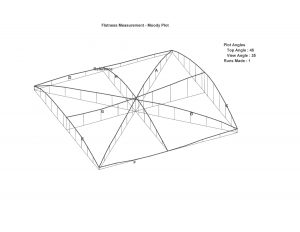
O teste de planicidade possui 4 métodos aprovados: níveis eletrônicos, autocolimação, laser e um dispositivo conhecido como localizador de plano. Utilizamos apenas níveis eletrônicos por serem o método mais preciso e rápido, por diversos motivos.
Os lasers e autocolimadores utilizam um feixe de luz muito reto como referência. A retilineidade de uma placa de granito é medida comparando-se a variação na distância entre a placa e o feixe de luz. Ao incidir um feixe de luz reto sobre um alvo refletor enquanto este se move ao longo da placa, a distância entre o feixe emitido e o feixe refletido representa a medida de retilineidade.
Eis o problema com esse método. O alvo e a fonte são afetados por vibração, temperatura ambiente, um alvo irregular ou riscado, contaminação do ar e movimento do ar (correntes). Todos esses fatores contribuem com componentes adicionais de erro. Além disso, a contribuição do erro do operador nas verificações com um autocolimador é ainda maior.
Um usuário experiente de autocolimador pode fazer medições muito precisas, mas ainda enfrenta problemas com a consistência das leituras, especialmente em distâncias maiores, pois os reflexos tendem a se alargar ou a ficar ligeiramente desfocados. Além disso, um alvo que não seja perfeitamente plano e um longo dia de observação através da lente também geram erros adicionais.
Um dispositivo de localização plana é simplesmente inadequado. Este dispositivo utiliza um feixe de luz relativamente reto (em comparação com um feixe de luz colimado ou laser extremamente reto) como referência. Além disso, o dispositivo mecânico utiliza um indicador com resolução normalmente de apenas 20 µm, e a irregularidade da barra e a presença de materiais diferentes contribuem significativamente para os erros de medição. Em nossa opinião, embora o método seja aceitável, nenhum laboratório competente jamais utilizaria um dispositivo de localização plana como instrumento de inspeção final.
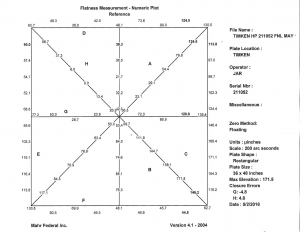
Os níveis eletrônicos utilizam a gravidade como referência. Os níveis eletrônicos diferenciais não são afetados por vibrações. Possuem resolução de até 0,1 segundo de arco e as medições são rápidas, precisas e com mínima contribuição de erros por parte de um operador experiente. Nem os localizadores planos nem os autocolimadores fornecem representações topográficas (Figura 1) ou isométricas (Figura 2) da superfície geradas por computador.
Figura 2
Teste de planicidade adequada da superfície
A planicidade adequada do teste de superfície é uma parte tão importante deste artigo que eu deveria tê-la incluído no início. Como mencionado anteriormente, a especificação federal GGG-p-463c NÃO é um método de calibração. Ela serve como guia para muitos aspectos do granito de grau metrológico, cujo comprador pretendido é qualquer agência do governo federal, incluindo os métodos de teste e as tolerâncias ou classificações. Se um contratante alegar que seguiu as especificações federais, o valor de planicidade deverá ser determinado pelo Método Moody.
Moody foi um sujeito lá dos anos 50 que criou um método matemático para determinar a planicidade geral e levar em conta a orientação das linhas testadas, verificando se elas estavam suficientemente próximas no mesmo plano. Nada mudou. A Allied Signal tentou aprimorar o método matemático, mas concluiu que as diferenças eram tão pequenas que não valia a pena o esforço.
Se um instalador de placas de superfície utiliza níveis eletrônicos ou laser, ele usa um computador para auxiliá-lo nos cálculos. Sem o auxílio do computador, o técnico que utiliza a autocolimação precisa calcular as leituras manualmente. Na realidade, isso não acontece. Levaria muito tempo e, francamente, poderia ser muito complexo. Em um teste de planicidade utilizando o Método Moody, o técnico testa oito linhas em formato de Union Jack para verificar a retidão.
O Método Moody
O Método Moody é uma forma matemática de determinar se as oito linhas estão no mesmo plano. Caso contrário, você teria apenas oito linhas retas que podem ou não estar no mesmo plano ou próximas a ele. Além disso, um contratista que alega seguir as especificações federais e usa autocolimação, eledeveGere oito páginas de dados. Uma página para cada linha verificada para comprovar seus testes, reparos ou ambos. Caso contrário, o empreiteiro não terá ideia do valor real de planicidade.
Tenho certeza de que, se você é daqueles que têm suas placas calibradas por um profissional usando autocolimação, nunca viu essas páginas! A Figura 3 é um exemplo deapenas umpágina oito necessária para calcular a planicidade geral. Um indício dessa ignorância e má-fé é se o seu relatório contém números arredondados. Por exemplo, 200, 400, 650, etc. Um valor calculado corretamente é um número real. Por exemplo, 325,4 µm. Quando o contratante utiliza o Método Moody para os cálculos e o técnico calcula os valores manualmente, você deve receber oito páginas de cálculos e um gráfico isométrico. O gráfico isométrico mostra as diferentes alturas ao longo das linhas e a distância entre os pontos de interseção selecionados.
Figura 3(São necessárias oito páginas como esta para calcular a planicidade manualmente. Certifique-se de perguntar por que você não está obtendo esse resultado se o seu instalador usa autocolimação!)
Figura 4
Os técnicos de medição dimensional utilizam níveis diferenciais (Figura 4) como dispositivos preferenciais para medir as mínimas variações de angularidade entre estações de medição. Os níveis possuem resolução de até 0,1 segundos de arco (5 µs de polegada usando um trenó de 4 polegadas), são extremamente estáveis e não são afetados por vibração, distâncias medidas, correntes de ar, fadiga do operador, contaminação do ar ou quaisquer problemas inerentes a outros dispositivos. Com o auxílio de computador, a tarefa torna-se relativamente rápida, gerando gráficos topográficos e isométricos que comprovam a verificação e, principalmente, o reparo.
Um teste de repetibilidade adequado
A leitura repetida, ou repetibilidade, é o teste mais importante. O equipamento que utilizamos para realizar o teste de repetibilidade consiste em um dispositivo de leitura repetida, um LVDT e um amplificador necessário para leituras de alta resolução. Configuramos o amplificador LVDT para uma resolução mínima de 10 µm/polegada ou 5 µm/polegada para placas de alta precisão.
Usar um indicador mecânico com resolução de apenas 20 µm é inútil se você estiver tentando testar um requisito de repetibilidade de 35 µm. Os indicadores têm uma incerteza de 40 µm! A configuração de leitura repetida simula uma configuração de medidor de altura/peça.
A repetibilidade NÃO é a mesma coisa que a planicidade geral (plano médio). Gosto de pensar na repetibilidade em granito como uma medição consistente do raio.
Figura 5
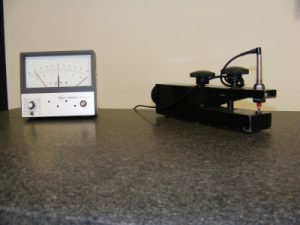
Se você testar a repetibilidade de uma esfera, terá demonstrado que o raio da esfera não se alterou. (O perfil ideal de uma placa devidamente reparada apresenta uma forma convexa.) No entanto, é evidente que a esfera não é plana. Bem, mais ou menos. Em distâncias extremamente curtas, ela é plana. Como a maioria das inspeções envolve um medidor de altura muito próximo da peça, a repetibilidade torna-se a propriedade mais crítica de uma placa de granito. Ela é mais importante do que a planicidade geral, a menos que o usuário esteja verificando a retidão de uma peça longa.
Certifique-se de que seu contratado realize um teste de leitura repetida. Uma placa pode apresentar uma leitura repetida significativamente fora da tolerância, mas ainda assim passar no teste de planicidade! Incrivelmente, um laboratório pode obter acreditação em testes que não incluem um teste de leitura repetida. Um laboratório que não consegue reparar ou não é muito bom em reparos prefere realizar apenas o teste de planicidade. A planicidade raramente muda, a menos que a placa seja movida.
O teste de repetibilidade é o mais fácil de testar, mas o mais difícil de executar em processos de lapidação. Certifique-se de que seu instalador consiga restaurar a repetibilidade sem danificar a superfície ou deixar ondulações.
Teste Delta T
Este teste envolve medir a temperatura REAL da pedra em sua superfície superior e em sua superfície inferior e calcular a diferença, Delta T, para constar no certificado.
É importante saber que o coeficiente médio de expansão térmica do granito é de 3,5 µin/pol/grau. O efeito da temperatura e da umidade ambiente em uma placa de granito é desprezível. No entanto, uma placa de superfície pode apresentar variações de temperatura, mesmo que dentro de uma diferença de 0,3 a 0,5 graus Fahrenheit, pode sair da tolerância ou até mesmo melhorar. É necessário verificar se a variação de temperatura está dentro de 0,12 graus Fahrenheit do valor diferencial em relação à última calibração.
É importante saber também que a superfície de trabalho de uma placa migra em direção ao calor. Se a temperatura superior for maior que a inferior, a superfície superior se eleva. Se a inferior for mais quente, o que é raro, a superfície superior afunda. Para um gerente de qualidade ou técnico, não basta saber se a placa está plana e repetível no momento da calibração ou reparo, mas sim qual era o seu Delta T no momento do teste final de calibração. Em situações críticas, o usuário pode, medindo o Delta T, determinar se uma placa saiu da tolerância devido exclusivamente a variações de Delta T. Felizmente, o granito leva muitas horas ou até dias para se aclimatar ao ambiente. Pequenas flutuações na temperatura ambiente ao longo do dia não o afetam. Por esses motivos, não relatamos a temperatura ou umidade ambiente de calibração, pois os efeitos são insignificantes.
Desgaste da placa de granito
Embora o granito seja mais duro que as chapas de aço, ele ainda desenvolve áreas rebaixadas em sua superfície. O movimento repetitivo de peças e instrumentos de medição sobre a chapa é a principal causa de desgaste, especialmente se a mesma área for utilizada constantemente. Sujeira e pó de retificação que permanecem na superfície da chapa aceleram o processo de desgaste, pois se acumulam entre as peças ou instrumentos de medição e a superfície do granito. Ao movimentar peças e instrumentos de medição sobre a superfície, o pó abrasivo geralmente causa desgaste adicional. Recomendo fortemente a limpeza constante para reduzir o desgaste. Já observamos desgaste em chapas causado por entregas diárias de encomendas da UPS colocadas diretamente sobre elas! Essas áreas localizadas de desgaste afetam as leituras dos testes de repetibilidade da calibração. Evite o desgaste limpando regularmente.
Limpeza de placa de granito
Para manter a placa limpa, use um pano adesivo para remover a sujeira. Pressione levemente para não deixar resíduos de cola. Um pano adesivo bem usado é excelente para remover a poeira da lixadeira entre as limpezas. Não trabalhe no mesmo lugar. Mova seu equipamento pela placa, distribuindo o desgaste. É possível usar álcool para limpar a placa, mas lembre-se de que isso resfriará a superfície temporariamente. Água com uma pequena quantidade de sabão é excelente. Produtos de limpeza comerciais, como o limpador da Starrett, também são ótimos, mas certifique-se de remover todo o resíduo de sabão da superfície.
Reparo de placa de granito
A esta altura, já deve estar evidente a importância de garantir que o fornecedor da sua placa de superfície realize uma calibração competente. Os laboratórios do tipo "Central de Compensação" que oferecem programas "Faça tudo em uma única ligação" raramente possuem um técnico capaz de realizar reparos. Mesmo quando oferecem reparos, nem sempre contam com um técnico com a experiência necessária quando a placa de superfície apresenta desvios significativos em relação à tolerância.
Se lhe disserem que uma placa não pode ser reparada devido a desgaste extremo, ligue-nos. Muito provavelmente, conseguiremos efetuar o reparo.
Nossos técnicos realizam um período de aprendizagem de um a um ano e meio sob a supervisão de um Técnico Mestre em Calibração de Placas de Superfície. Definimos um Técnico Mestre em Calibração de Placas de Superfície como alguém que concluiu seu período de aprendizagem e possui mais de dez anos de experiência adicional em calibração e reparo de placas de superfície. Na Dimensional Gauge, contamos com três Técnicos Mestres em nossa equipe, com mais de 60 anos de experiência combinada. Um de nossos Técnicos Mestres está sempre disponível para oferecer suporte e orientação em situações complexas. Todos os nossos técnicos possuem experiência em calibração de placas de superfície de todos os tamanhos, desde pequenas até muito grandes, em diversas condições ambientais, em diferentes setores e em problemas de desgaste acentuado.
As especificações da Fed exigem um acabamento com rugosidade aritmética média (AA) de 16 a 64. Preferimos um acabamento na faixa de 30 a 35 AA. Essa rugosidade é suficiente para garantir que as peças e os instrumentos de medição se movam suavemente e não grudem ou se deformem na placa de superfície.
Ao realizar o reparo, inspecionamos a placa para garantir a montagem e o nivelamento corretos. Utilizamos o método de lapidação a seco, mas, em casos de desgaste extremo que exigem remoção significativa de granito, fazemos a lapidação úmida. Nossos técnicos limpam tudo após o trabalho, são minuciosos, rápidos e precisos. Isso é importante porque o custo do serviço de reparo de placas de granito inclui o tempo de inatividade e a perda de produção. Um reparo competente é fundamental, e você nunca deve escolher um prestador de serviços com base no preço ou na conveniência. Alguns trabalhos de calibração exigem profissionais altamente treinados. E nós temos esses profissionais.
Relatórios finais de calibração
Para cada reparo e calibração de placa de superfície, fornecemos relatórios profissionais detalhados. Nossos relatórios contêm uma quantidade significativa de informações críticas e pertinentes. A Fed Spec. exige a maior parte das informações que fornecemos. Excluindo aquelas contidas em outras normas de qualidade, como a ISO/IEC-17025, as especificações mínimas da Fed. para os relatórios são:
- Dimensões em pés (X' x X')
- Cor
- Estilo (Refere-se a ausência de bordas de fixação ou a duas ou quatro bordas)
- Módulo de elasticidade estimado
- Tolerância média do plano (determinada pela classe/tamanho)
- Tolerância de leitura repetida (determinada pelo comprimento da diagonal em polegadas)
- Plano médio conforme encontrado
- Plano médio à esquerda
- Repita a leitura conforme encontrado.
- Repita a leitura à esquerda.
- Delta T (Diferencial de temperatura entre as superfícies superior e inferior)
Caso o técnico precise realizar trabalhos de lapidação ou reparo na placa de superfície, o certificado de calibração deverá ser acompanhado de um mapa topográfico ou isométrico para comprovar a validade do reparo.
Algumas palavras sobre as acreditações ISO/IEC-17025 e os laboratórios que as possuem.
O simples fato de um laboratório possuir acreditação em calibração de placas de superfície não significa necessariamente que seus profissionais saibam o que estão fazendo, muito menos que o façam corretamente! Tampouco implica necessariamente que o laboratório seja capaz de realizar reparos. Os órgãos de acreditação não fazem distinção entre verificação e calibração (reparo).AE eu conheço um, talvez.2órgãos de acreditação que irãoLgravataASe eu pagasse o suficiente, colocaria uma fita no meu cachorro! É uma triste realidade. Já vi laboratórios conseguirem acreditação realizando apenas um dos três testes exigidos. Além disso, já vi laboratórios conseguirem acreditação com incertezas irreais e sem qualquer prova ou demonstração de como calcularam os valores. É tudo lamentável.
Soma
Não se pode subestimar a importância das placas de granito de precisão. A referência plana que as placas de granito proporcionam é a base sobre a qual se realizam todas as outras medições.
Você pode utilizar os instrumentos de medição mais modernos, precisos e versáteis. No entanto, medições precisas são difíceis de obter se a superfície de referência não for plana. Certa vez, um cliente em potencial me disse: "Bem, é só pedra!". Minha resposta foi: "Certo, você está certo, e definitivamente não pode justificar a contratação de especialistas para fazer a manutenção das suas placas de superfície."
O preço nunca é um bom motivo para escolher fornecedores de placas de superfície. Compradores, contadores e um número preocupante de engenheiros de qualidade nem sempre entendem que recertificar placas de granito não é como recertificar um micrômetro, um paquímetro ou um multímetro digital.
Alguns instrumentos exigem conhecimento especializado, não apenas preço baixo. Dito isso, nossas tarifas são muito razoáveis. Principalmente pela confiança que você tem na execução correta do trabalho. Vamos muito além dos requisitos das normas ISO-17025 e das especificações federais em valor agregado.
As placas de superfície são a base para muitas medições dimensionais, e o cuidado adequado com a sua placa de superfície é necessário para garantir a precisão das medições.
O granito é o material mais popular para placas de superfície devido às suas características físicas ideais, como dureza superficial e baixa sensibilidade a variações de temperatura. No entanto, com o uso contínuo, as placas de superfície sofrem desgaste.
A planicidade e a repetibilidade são aspectos críticos para determinar se uma placa oferece uma superfície precisa para a obtenção de medições exatas. As tolerâncias para ambos os aspectos são definidas pelas especificações federais GGG-P-463C, DIN, GB, JJS, etc. A planicidade mede a distância entre o ponto mais alto (o plano superior) e o ponto mais baixo (o plano inferior) da placa. A repetibilidade determina se uma medição feita em uma área pode ser repetida em toda a placa dentro da tolerância especificada. Isso garante que não haja picos ou vales na placa. Se as leituras não estiverem dentro das diretrizes estabelecidas, pode ser necessário refazer a superfície para que as medições voltem a estar dentro das especificações.
A calibração rotineira de placas de superfície é necessária para garantir planicidade e repetibilidade ao longo do tempo. O grupo de medição de precisão da Cross possui acreditação ISO 17025 para calibração de planicidade e repetibilidade de placas de superfície. Utilizamos o Sistema de Certificação de Placas de Superfície Mahr, que inclui:
- Análise de humor e perfil,
- Gráficos isométricos ou numéricos,
- Média de Execução Múltipla e
- Classificação automática de acordo com os padrões da indústria.
O modelo assistido por computador Mahr determina qualquer desvio angular ou linear do nível absoluto e é ideal para a criação de perfis de alta precisão em placas de superfície.
Os intervalos entre as calibrações variam dependendo da frequência de uso, das condições ambientais do local onde a placa está instalada e dos requisitos de qualidade específicos da sua empresa. A manutenção adequada da sua placa de superfície pode permitir intervalos maiores entre cada calibração, ajuda a evitar o custo adicional de recalibração e, mais importante, garante que as medições obtidas na placa sejam as mais precisas possíveis. Embora as placas de superfície pareçam robustas, são instrumentos de precisão e devem ser tratadas como tal. Aqui estão alguns pontos a considerar em relação aos cuidados com suas placas de superfície:
- Mantenha o prato limpo e, se possível, cubra-o quando não estiver em uso.
- Nada deve ser colocado na placa além de instrumentos de medição ou peças a serem medidas.
- Não use sempre o mesmo lugar no prato.
- Se possível, gire o prato periodicamente.
- Respeite o limite de carga da sua placa.
A base de granito de precisão pode melhorar o desempenho das máquinas-ferramenta.
As exigências na engenharia mecânica em geral e na construção de máquinas-ferramenta em particular estão em constante crescimento. Alcançar a máxima precisão e desempenho sem aumentar os custos é um desafio constante para a competitividade. A base da máquina-ferramenta é um fator decisivo nesse contexto. Por isso, cada vez mais fabricantes de máquinas-ferramenta estão optando pelo granito. Devido às suas propriedades físicas, ele oferece vantagens claras que não podem ser obtidas com aço ou concreto polimérico.
O granito é uma rocha vulcânica profunda, com estrutura muito densa e homogênea, coeficiente de expansão extremamente baixo, baixa condutividade térmica e alta capacidade de amortecimento de vibrações.
A seguir, você descobrirá por que a opinião comum de que o granito é adequado principalmente como base para máquinas de medição por coordenadas de alta precisão está ultrapassada e por que esse material natural, como base para máquinas-ferramenta, é uma alternativa muito vantajosa ao aço ou ao ferro fundido, mesmo para máquinas-ferramenta de alta precisão.
Podemos fabricar componentes de granito para movimento dinâmico, componentes de granito para motores lineares, componentes de granito para ensaios não destrutivos (END), componentes de granito para raios X, componentes de granito para máquinas de medição por coordenadas (CMM), componentes de granito para máquinas CNC, componentes de precisão em granito para laser, componentes de granito para a indústria aeroespacial, componentes de granito para mesas de precisão...
Alto valor agregado sem custos adicionais
O uso crescente de granito na engenharia mecânica não se deve tanto ao aumento expressivo do preço do aço. Em vez disso, deve-se ao fato de que o valor agregado para a máquina-ferramenta, obtido com uma base de granito, é possível a um custo adicional mínimo ou inexistente. Isso é comprovado por comparações de custos entre fabricantes renomados de máquinas-ferramenta na Alemanha e na Europa.
O ganho considerável em estabilidade termodinâmica, amortecimento de vibrações e precisão a longo prazo proporcionado pelo granito não pode ser alcançado com uma base de ferro fundido ou aço, ou apenas a um custo relativamente alto. Por exemplo, erros térmicos podem representar até 75% do erro total de uma máquina, sendo a compensação frequentemente tentada por software – com sucesso moderado. Devido à sua baixa condutividade térmica, o granito é a melhor base para precisão a longo prazo.
Com uma tolerância de 1 μm, o granito atende facilmente aos requisitos de planicidade da norma DIN 876 para o grau de precisão 00. Com um valor de 6 na escala de dureza de 1 a 10, é extremamente duro e, com seu peso específico de 2,8 g/cm³, quase atinge o valor do alumínio. Isso também resulta em vantagens adicionais, como maiores taxas de avanço, maiores acelerações nos eixos e maior vida útil da ferramenta para máquinas-ferramenta de corte. Assim, a substituição de uma base de ferro fundido por uma base de granito coloca a máquina-ferramenta em questão na classe de alta precisão e desempenho – sem custo adicional.
Pegada ecológica aprimorada da Granite
Ao contrário de materiais como o aço ou o ferro fundido, a pedra natural não exige grande consumo de energia nem o uso de aditivos em sua produção. Apenas quantidades relativamente pequenas de energia são necessárias para a extração e o tratamento da superfície. Isso resulta em uma pegada ecológica inferior, que mesmo ao final da vida útil de uma máquina supera a do aço como material. O leito de granito pode servir de base para uma nova máquina ou ser utilizado para fins completamente diferentes, como a trituração de material para a construção de estradas.
Além disso, não há escassez de recursos de granito. Trata-se de uma rocha profunda formada a partir do magma no interior da crosta terrestre. Ela "amadureceu" ao longo de milhões de anos e está disponível em grandes quantidades como recurso natural em quase todos os continentes, incluindo toda a Europa.
Conclusão: As inúmeras vantagens demonstráveis do granito em comparação com o aço ou o ferro fundido justificam a crescente disposição dos engenheiros mecânicos em utilizar esse material natural como base para máquinas-ferramenta de alta precisão e alto desempenho. Informações detalhadas sobre as propriedades do granito, que são vantajosas para máquinas-ferramenta e engenharia mecânica, podem ser encontradas neste artigo complementar.
Uma medição repetida é uma medição de áreas de planicidade localizadas. A especificação de Medição Repetida estabelece que uma medição feita em qualquer ponto da superfície de uma placa se repetirá dentro da tolerância especificada. Controlar a planicidade de áreas localizadas com maior rigor do que a planicidade geral garante uma mudança gradual no perfil de planicidade da superfície, minimizando assim os erros locais.
A maioria dos fabricantes, incluindo marcas importadas, segue a Especificação Federal para tolerâncias de planicidade geral, mas muitos negligenciam as medições repetidas. Muitas das chapas de baixo custo disponíveis no mercado atualmente não garantem medições repetidas. Um fabricante que não garante medições repetidas NÃO está produzindo chapas que atendam aos requisitos da ASME B89.3.7-2013, da Especificação Federal GGG-P-463c, ou das normas DIN 876, GB, JJS...
Ambos são cruciais para garantir uma superfície precisa para medições exatas. A especificação de planicidade por si só não é suficiente para garantir a precisão da medição. Considere, por exemplo, uma placa de superfície de 36 x 48 polegadas com classificação de inspeção A, que atende APENAS à especificação de planicidade de 0,000300 polegadas. Se a peça inspecionada abranger vários picos e o instrumento de medição estiver em um ponto baixo, o erro de medição poderá ser a tolerância total em uma área, 0,000300 polegadas! Na verdade, pode ser muito maior se o instrumento de medição estiver apoiado na inclinação de um plano inclinado.
Erros de 0,000600" a 0,000800" são possíveis, dependendo da severidade da inclinação e do comprimento do braço do medidor utilizado. Se esta placa tivesse uma especificação de Medição Repetida de 0,000050" FIR, o erro de medição seria inferior a 0,000050", independentemente do local da medição na placa. Outro problema, que geralmente surge quando um técnico sem treinamento tenta refazer o acabamento de uma placa no local, é o uso exclusivo de Medições Repetidas para certificar uma placa.
Os instrumentos utilizados para verificar a repetibilidade NÃO são projetados para verificar a planicidade geral. Quando zerados em uma superfície perfeitamente curva, eles continuarão a indicar zero, independentemente de a superfície ser perfeitamente plana, perfeitamente côncava ou convexa em 1/2 polegada! Eles simplesmente verificam a uniformidade da superfície, não a planicidade. Somente uma placa que atenda tanto à especificação de planicidade quanto à especificação de repetibilidade de medição realmente atende aos requisitos da norma ASME B89.3.7-2013 ou da Especificação Federal GGG-P-463c.
Ask us about or flatness specification and repeat measurement promise by calling +86 19969991659 or emailing INFO@ZHHIMG.COM
Sim, mas a precisão só pode ser garantida para um gradiente de temperatura vertical específico. Os efeitos da expansão térmica na placa podem facilmente causar uma alteração na precisão superior à tolerância, caso haja uma mudança no gradiente. Em alguns casos, se a tolerância for suficientemente apertada, o calor absorvido pela iluminação superior pode causar uma alteração de gradiente significativa ao longo de várias horas.
O granito possui um coeficiente de expansão térmica de aproximadamente 0,0000035 polegadas por polegada por 1°F. Por exemplo: uma placa de superfície de 36" x 48" x 8" tem uma precisão de 0,000075" (metade da Grau AA) com um gradiente de 0°F, onde a parte superior e inferior estão na mesma temperatura. Se a parte superior da placa aquecer até o ponto em que estiver 1°F mais quente que a inferior, a precisão mudaria para 0,000275" convexa! Portanto, encomendar uma placa com uma tolerância mais rigorosa que a Grau AA de Laboratório só deve ser considerado se houver controle climático adequado.
Uma placa de superfície deve ser apoiada em 3 pontos, idealmente localizados a 20% do comprimento a partir das extremidades da placa. Dois apoios devem ser localizados a 20% da largura a partir dos lados maiores, e o apoio restante deve ser centralizado. Somente 3 pontos podem se apoiar firmemente em qualquer superfície que não seja de precisão.
A placa deve ser apoiada nesses pontos durante a produção e somente nesses três pontos durante o uso. Tentar apoiar a placa em mais de três pontos fará com que ela receba suporte de várias combinações de três pontos, que não serão os mesmos três pontos em que foi apoiada durante a produção. Isso introduzirá erros, pois a placa se deformará para se adequar à nova configuração de suporte. Todos os suportes de aço da zhhimg possuem vigas de suporte projetadas para se alinharem com os pontos de apoio corretos.
Se a placa estiver devidamente apoiada, o nivelamento preciso só é necessário se a sua aplicação o exigir. O nivelamento não é necessário para manter a precisão de uma placa devidamente apoiada.
Por que escolher granito paraBases de máquinaseComponentes de Metrologia?
A resposta é "sim" para quase todas as aplicações. As vantagens do granito incluem: ausência de ferrugem ou corrosão, praticamente imunidade a deformações, ausência de saliência compensatória em caso de lascas, maior vida útil, ação mais suave, maior precisão, praticamente não magnético, baixo coeficiente de expansão térmica e baixo custo de manutenção.
O granito é um tipo de rocha ígnea extraída por sua extrema resistência, densidade, durabilidade e resistência à corrosão. Mas o granito também é muito versátil – não serve apenas para quadrados e retângulos! Na verdade, a Starrett Tru-Stone trabalha com confiança com componentes de granito projetados em formatos, ângulos e curvas de todas as variações regularmente – com excelentes resultados.
Graças ao nosso processamento de última geração, as superfícies de corte podem ser excepcionalmente planas. Essas qualidades fazem do granito o material ideal para criar bases de máquinas e componentes de metrologia com dimensões e designs personalizados. O granito é:
usinável
precisamente plano quando cortado e acabado
resistente à ferrugem
durável
duradouro
Os componentes de granito também são fáceis de limpar. Ao criar projetos personalizados, certifique-se de escolher o granito por seus benefícios superiores.
NORMAS/ APLICAÇÕES DE ALTO DESGASTE
O granito utilizado pela ZhongHui para os nossos produtos de placas de superfície padrão possui alto teor de quartzo, o que proporciona maior resistência ao desgaste e danos. Nossas cores Preto Superior e Rosa Cristal têm baixas taxas de absorção de água, minimizando a possibilidade de ferrugem dos seus instrumentos de medição de precisão enquanto estiverem sobre as placas. As cores de granito oferecidas pela ZhongHui resultam em menor brilho, o que significa menos cansaço visual para quem utiliza as placas. Selecionamos nossos tipos de granito considerando a expansão térmica, buscando minimizar esse aspecto.
APLICAÇÕES PERSONALIZADAS
Quando sua aplicação exigir uma placa com formatos personalizados, insertos roscados, ranhuras ou outros acabamentos usinados, você deve selecionar um material como o Diabásio Preto. Este material natural oferece rigidez superior, excelente amortecimento de vibrações e usinabilidade aprimorada.
Sim, desde que não estejam muito desgastadas. Nossa fábrica e equipamentos proporcionam as condições ideais para a calibração adequada das chapas e retrabalho, se necessário. Geralmente, se uma chapa estiver dentro de 0,001" da tolerância exigida, ela pode ser retificada no local. Se uma chapa estiver desgastada a ponto de estar mais de 0,001" fora da tolerância, ou se estiver muito corroída ou com marcas de desgaste, ela precisará ser enviada à fábrica para retificação antes da retificação.
É preciso ter muita cautela ao selecionar um técnico para calibração e restauração de granito no local. Recomendamos que você seja criterioso na escolha do seu serviço de calibração. Solicite credenciamento e verifique se o equipamento que o técnico utilizará possui calibração rastreável por uma Instituição Nacional de Inspeção. Aprender a lapidar granito de precisão corretamente leva muitos anos.
A ZhongHui oferece prazos de entrega rápidos para calibrações realizadas em nossa fábrica. Se possível, envie suas placas para calibração. Sua qualidade e reputação dependem da precisão de seus instrumentos de medição, incluindo placas de superfície!
Nossas placas de superfície preta possuem uma densidade significativamente maior e são até três vezes mais rígidas. Portanto, uma placa feita de preto não precisa ser tão espessa quanto uma placa de granito do mesmo tamanho para ter resistência à deflexão igual ou superior. Menor espessura significa menor peso e custos de envio mais baixos.
Cuidado com quem usa granito preto de qualidade inferior na mesma espessura. Como mencionado anteriormente, as propriedades do granito, assim como as da madeira ou do metal, variam de acordo com o material e a cor, e não são um indicador preciso de rigidez, dureza ou resistência ao desgaste. Aliás, muitos tipos de granito preto e diabásio são muito macios e inadequados para aplicações em placas de superfície.
Não. O equipamento especializado e o treinamento necessários para retrabalhar esses itens exigem que eles sejam devolvidos à fábrica para calibração e retrabalho.
Sim. A cerâmica e o granito têm características semelhantes, e os métodos usados para calibrar e lapidar granito também podem ser usados em peças de cerâmica. A cerâmica é mais difícil de lapidar do que o granito, o que resulta em um custo mais elevado.
Sim, desde que os insertos estejam rebaixados abaixo da superfície. Se os insertos de aço estiverem nivelados ou acima do plano da superfície, eles devem ser retificados antes que a chapa possa ser lapidada. Se necessário, podemos fornecer esse serviço.
Sim. Inserções de aço com a rosca desejada (inglesa ou métrica) podem ser fixadas com epóxi na placa nos locais desejados. A ZhongHui utiliza máquinas CNC para garantir a máxima precisão na localização das inserções, com tolerância de +/- 0,005”. Para inserções menos críticas, nossa tolerância de localização para inserções roscadas é de ±0,060”. Outras opções incluem barras em T de aço e ranhuras em cauda de andorinha usinadas diretamente no granito.
Insertos devidamente colados com epóxi de alta resistência e com boa mão de obra suportam grandes forças de torção e cisalhamento. Em um teste recente, utilizando insertos roscados de 3/8"-16, um laboratório independente mediu a força necessária para arrancar um inserto colado com epóxi de uma placa de superfície. Dez placas foram testadas. Dessas dez, em nove casos, o granito fraturou primeiro. A carga média no ponto de ruptura foi de 4.548 kg (10.020 lbs) para granito cinza e 5.581 kg (12.310 lbs) para granito preto. No único caso em que um inserto se soltou da placa, a carga no ponto de ruptura foi de 5.899 kg (12.990 lbs)! Se uma peça de trabalho formar uma ponte sobre o inserto e um torque extremo for aplicado, é possível gerar força suficiente para fraturar o granito. Em parte por esse motivo, a ZhongHui fornece diretrizes para o torque máximo seguro que pode ser aplicado aos insertos colados com epóxi: https://www.zhhimg.com/standard-thread-inserts-product/
Sim, mas apenas em nossa fábrica. Em nossa unidade, podemos restaurar praticamente qualquer chapa, deixando-a como nova, geralmente por menos da metade do custo de substituição. Bordas danificadas podem ser reparadas esteticamente, sulcos profundos, entalhes e cavidades podem ser removidos por retificação, e os suportes podem ser substituídos. Além disso, podemos modificar sua chapa para aumentar sua versatilidade, adicionando insertos de aço maciço ou roscado e cortando ranhuras ou abas de fixação, conforme suas especificações.
Por que escolher granito?
O granito é um tipo de rocha ígnea formada na Terra há milhões de anos. A composição da rocha ígnea contém muitos minerais, como o quartzo, que é extremamente duro e resistente ao desgaste. Além da dureza e da resistência ao desgaste, o granito tem aproximadamente metade do coeficiente de expansão do ferro fundido. Como seu peso volumétrico é aproximadamente um terço do do ferro fundido, o granito é mais fácil de manusear.
Para bases de máquinas e componentes de metrologia, o granito preto é a cor mais utilizada. O granito preto possui uma porcentagem maior de quartzo do que outras cores e, portanto, é o mais resistente ao desgaste.
O granito tem um bom custo-benefício e as superfícies cortadas podem ser excepcionalmente planas. Além de poder ser lapidado manualmente para atingir extrema precisão, o recondicionamento pode ser feito sem a necessidade de remover a placa ou a mesa do local. Trata-se de uma operação de lapidação totalmente manual, que geralmente custa muito menos do que o recondicionamento de uma alternativa de ferro fundido.
Essas qualidades fazem do granito o material ideal para criar bases de máquinas e componentes de metrologia com dimensões e designs personalizados, como osuperfície de granito.
A ZhongHui produz peças de granito sob medida, criadas para atender a requisitos de medidas específicos. Esses itens sob medida variam debordas retas totriângulos quadradosDevido à natureza versátil do granito, ocomponentesPodem ser produzidos em qualquer tamanho necessário; são resistentes e duráveis.
Vantagens das placas de superfície de granito
A importância de medir em uma superfície plana foi estabelecida pelo inventor britânico Henry Maudsley no século XIX. Como inovador em máquinas-ferramenta, ele determinou que a produção consistente de peças exigia uma superfície sólida para medições confiáveis.
A revolução industrial criou uma demanda por superfícies de medição, então a empresa de engenharia Crown Windley criou padrões de fabricação. Os padrões para placas de superfície foram estabelecidos pela primeira vez pela Crown em 1904, utilizando metal. À medida que a demanda e o custo do metal aumentavam, materiais alternativos para a superfície de medição foram investigados.
Nos Estados Unidos, o criador de monumentos Wallace Herman estabeleceu que o granito preto era uma excelente alternativa ao metal para o material de placas de superfície. Como o granito não é magnético e não enferruja, logo se tornou a superfície de medição preferida.
Uma placa de granito é um investimento essencial para laboratórios e instalações de teste. Uma placa de granito de 600 x 600 mm pode ser montada em um suporte. Os suportes proporcionam uma altura de trabalho de 34” (0,86 m) com cinco pontos ajustáveis para nivelamento.
Para obter resultados de medição confiáveis e consistentes, uma placa de granito é fundamental. Como a superfície é lisa e estável, permite que os instrumentos sejam manipulados com cuidado.
As principais vantagens das placas de granito para superfícies são:
• Não reflexivo
• Resistente a produtos químicos e à corrosão
• Baixo coeficiente de expansão em comparação com o ferro fundido, sendo, portanto, menos afetado por variações de temperatura.
• Naturalmente rígido e resistente
• A superfície permanece plana mesmo se arranhada.
• Não enferruja
• Não magnético
• Fácil de limpar e manter
• A calibração e o recondicionamento podem ser feitos no local.
• Adequado para furação de insertos de suporte roscados
• Alto amortecimento de vibrações
Para muitas oficinas, salas de inspeção e laboratórios, as placas de granito de precisão são essenciais como base para medições exatas. Como toda medição linear depende de uma superfície de referência precisa a partir da qual as dimensões finais são obtidas, as placas de granito oferecem o melhor plano de referência para inspeção e preparação da peça antes da usinagem. Elas também são bases ideais para medições de altura e superfícies de referência. Além disso, o alto grau de planicidade, estabilidade, qualidade geral e acabamento fazem delas uma excelente opção para a montagem de sistemas sofisticados de medição mecânica, eletrônica e óptica. Para qualquer um desses processos de medição, é imprescindível manter as placas de granito calibradas.
Repita as medições e verifique a planicidade.
Tanto a planicidade quanto as medições repetidas são cruciais para garantir uma superfície de precisão. A planicidade pode ser considerada como a condição em que todos os pontos da superfície estão contidos em dois planos paralelos: o plano da base e o plano do topo. A medição da distância entre esses planos representa a planicidade geral da superfície. Essa medição de planicidade geralmente inclui uma tolerância e pode ser classificada por grau.
As tolerâncias de planicidade para três classes padrão são definidas na especificação federal, conforme determinado pela seguinte fórmula:
Grau de laboratório AA = (40 + diagonal² / 25) x 0,000001 polegada (unilateral)
Grau de Inspeção A = Grau de Laboratório AA x 2
Ferramentaria Grau B = Laboratório Grau AA x 4
Além da planicidade, a repetibilidade deve ser garantida. Uma medição repetida é uma medição de áreas de planicidade localizadas. Trata-se de uma medição realizada em qualquer ponto da superfície de uma placa, que se repetirá dentro da tolerância especificada. Controlar a planicidade de áreas localizadas com uma tolerância mais rigorosa do que a planicidade geral garante uma mudança gradual no perfil de planicidade da superfície, minimizando, assim, erros locais.
Para garantir que uma placa de superfície atenda às especificações de planicidade e repetibilidade de medições, os fabricantes de placas de granito devem usar a norma federal GGG-P-463c como base para suas especificações. Esta norma aborda a precisão da repetibilidade das medições, as propriedades do material do granito para placas de superfície, o acabamento superficial, a localização dos pontos de apoio, a rigidez, os métodos aceitáveis de inspeção e a instalação de insertos roscados.
Antes que uma placa de superfície se desgaste além do especificado para planicidade geral, ela apresentará postes desgastados ou ondulados. A inspeção mensal para erros de medição repetida, utilizando um medidor de leitura repetida, identificará os pontos de desgaste. Um medidor de leitura repetida é um instrumento de alta precisão que detecta erros locais e pode exibir as informações em um amplificador eletrônico de alta ampliação.
Verificação da precisão da placa
Seguindo algumas diretrizes simples, o investimento em uma placa de superfície de granito deve durar muitos anos. Dependendo do uso da placa, do ambiente da oficina e da precisão necessária, a frequência de verificação da precisão da placa de superfície varia. Uma regra geral é que uma placa nova seja totalmente recalibrada dentro de um ano após a compra. Se a placa for usada com frequência, é aconselhável reduzir esse intervalo para seis meses.
Antes que uma placa de superfície se desgaste além do especificado para planicidade geral, ela apresentará postes desgastados ou ondulados. A inspeção mensal para erros de medição repetida, utilizando um medidor de leitura repetida, identificará os pontos de desgaste. Um medidor de leitura repetida é um instrumento de alta precisão que detecta erros locais e pode exibir as informações em um amplificador eletrônico de alta ampliação.
Um programa de inspeção eficaz deve incluir verificações regulares com um autocolimador, fornecendo uma calibração precisa da planicidade geral, rastreável ao Instituto Nacional de Padrões e Tecnologia (NIST). Periodicamente, é necessária uma calibração completa realizada pelo fabricante ou por uma empresa independente.
Variações entre calibrações
Em alguns casos, existem variações entre as calibrações das placas de inspeção de superfície. Às vezes, fatores como alterações na superfície resultantes do desgaste, uso incorreto do equipamento de inspeção ou uso de equipamento não calibrado podem explicar essas variações. Os dois fatores mais comuns, no entanto, são a temperatura e o suporte.
Uma das variáveis mais importantes é a temperatura. Por exemplo, a superfície pode ter sido lavada com uma solução quente ou fria antes da calibração e não ter tido tempo suficiente para normalizar. Outras causas de variação de temperatura incluem correntes de ar frio ou quente, luz solar direta, iluminação direta ou outras fontes de calor radiante na superfície da placa.
Também podem ocorrer variações no gradiente vertical de temperatura entre o inverno e o verão. Em alguns casos, a placa não tem tempo suficiente para normalizar após o envio. É recomendável registrar o gradiente vertical de temperatura no momento da calibração.
Outra causa comum de variação na calibração é uma placa mal apoiada. Uma placa de superfície deve ser apoiada em três pontos, idealmente localizados a 20% do comprimento a partir das extremidades da placa. Dois apoios devem estar localizados a 20% da largura a partir dos lados maiores, e o apoio restante deve estar centralizado.
Apenas três pontos podem se apoiar firmemente em qualquer superfície que não seja de precisão. Tentar apoiar a chapa em mais de três pontos fará com que ela receba suporte de várias combinações de três pontos, que não serão os mesmos três pontos em que foi apoiada durante a produção. Isso introduzirá erros, pois a chapa se deformará para se adequar à nova configuração de suporte. Considere o uso de suportes de aço com vigas de apoio projetadas para se alinharem com os pontos de apoio corretos. Suportes para essa finalidade geralmente estão disponíveis junto ao fabricante da chapa.
Se a placa estiver devidamente apoiada, o nivelamento preciso só é necessário se a aplicação o especificar. O nivelamento não é necessário para manter a precisão de uma placa devidamente apoiada.
É importante manter a placa limpa. A poeira abrasiva em suspensão no ar é geralmente a maior causa de desgaste em uma placa, pois tende a se incrustar nas peças e nas superfícies de contato dos instrumentos de medição. Cubra as placas para protegê-las da poeira e de danos. A vida útil pode ser prolongada cobrindo a placa quando não estiver em uso.
Prolongue a vida útil do prato
Seguir algumas orientações simples reduzirá o desgaste da superfície da placa de granito e, consequentemente, prolongará sua vida útil.
Primeiramente, é importante manter a placa limpa. A poeira abrasiva em suspensão no ar geralmente é a maior causa de desgaste em uma placa, pois tende a se incrustar nas peças e nas superfícies de contato dos instrumentos de medição.
Também é importante cobrir as placas para protegê-las contra poeira e danos. A vida útil pode ser prolongada cobrindo as placas quando não estiverem em uso.
Gire a placa periodicamente para que uma única área não sofra desgaste excessivo. Além disso, recomenda-se substituir as almofadas de contato de aço dos medidores por almofadas de carboneto.
Evite colocar alimentos ou refrigerantes no prato. Muitos refrigerantes contêm ácido carbônico ou fosfórico, que podem dissolver os minerais mais macios e deixar pequenas cavidades na superfície.
Onde recair
Quando uma placa de granito precisa ser retificada, considere se o serviço deve ser realizado no local ou na empresa de calibração. É sempre preferível retificar a placa na fábrica ou em uma instalação especializada. No entanto, se a placa não estiver muito desgastada, geralmente dentro de 0,001 polegada da tolerância exigida, ela pode ser retificada no local. Se uma placa estiver desgastada a ponto de estar mais de 0,001 polegada fora da tolerância, ou se estiver muito corroída ou com marcas, ela deve ser enviada à fábrica para retificação antes da retificação.
Um laboratório de calibração possui os equipamentos e a configuração de fábrica que proporcionam as condições ideais para a calibração adequada das placas e, se necessário, para retrabalho.
É preciso ter muito cuidado ao selecionar um técnico para calibração e retífica de granito no local. Solicite credenciamento e verifique se o equipamento que o técnico utilizará possui calibração rastreável pelo NIST. A experiência também é um fator importante, pois leva muitos anos para aprender a lapidar granito de precisão corretamente.
Medições críticas começam com uma placa de granito de precisão como referência. Ao garantir uma referência confiável por meio de uma placa calibrada adequadamente, os fabricantes dispõem de uma das ferramentas essenciais para medições precisas e peças de melhor qualidade.
Lista de verificação para variações de calibração
- A superfície foi lavada com uma solução quente ou fria antes da calibração e não teve tempo suficiente para normalizar.
- A placa não está apoiada corretamente.
- Mudança de temperatura.
- Rascunhos.
- Evite a incidência direta da luz solar ou outras fontes de calor radiante na superfície do prato. Certifique-se de que a iluminação superior não esteja aquecendo a superfície.
- Variações no gradiente vertical de temperatura entre o inverno e o verão. Se possível, conheça o gradiente vertical de temperatura no momento em que a calibração for realizada.
- A placa não teve tempo suficiente para normalizar após o envio.
- Uso inadequado de equipamentos de inspeção ou uso de equipamentos não calibrados.
- Alteração superficial resultante do desgaste.
Dicas de tecnologia
Como toda medição linear depende de uma superfície de referência precisa a partir da qual as dimensões finais são obtidas, as placas de superfície fornecem o melhor plano de referência para inspeção e marcação da peça antes da usinagem.
Controlar a planicidade da área local com uma tolerância mais rigorosa do que a planicidade geral garante uma mudança gradual no perfil de planicidade da superfície, minimizando assim os erros locais.